


India Review & Analysis: Lasers and Sanskrit link India and Lithuania
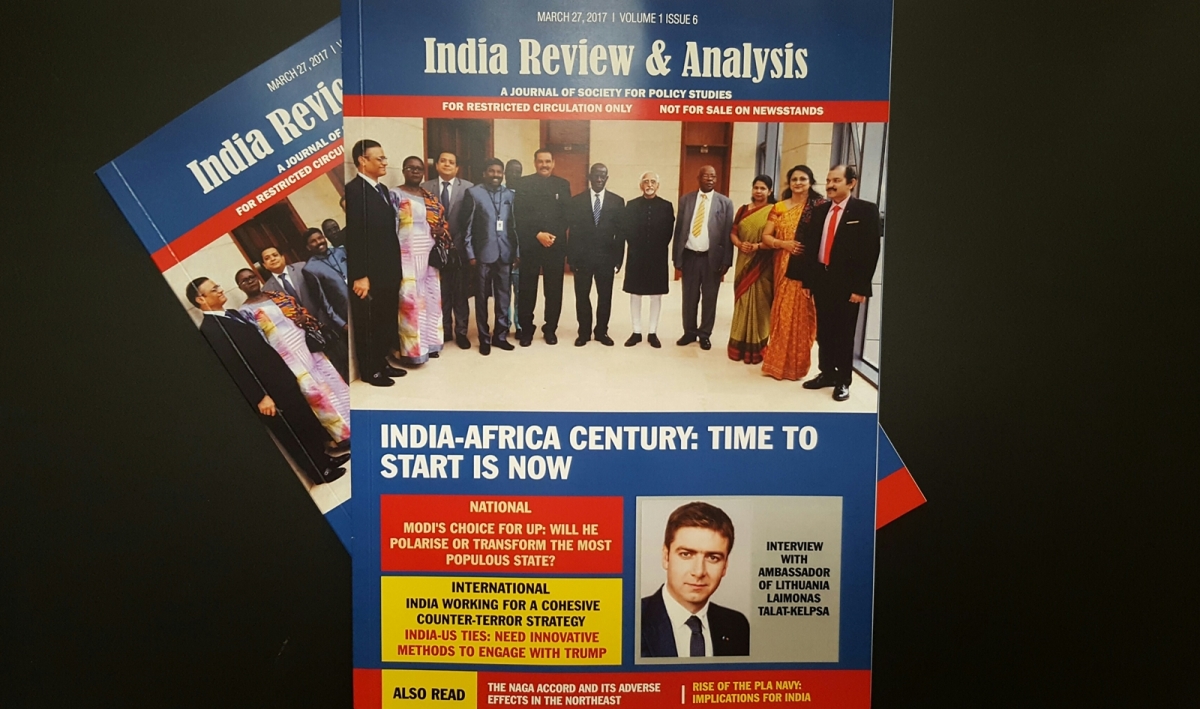
Bilateral ties are set to grow as India and Lithuania celebrate 25 years of their diplomatic relations.
India recognized Lithuania (along with the other Baltic States of Latvia and Estonia) on 7th September 1991 after they regained independence from the erstwhile USSR. Diplomatic relations were established with Lithuania on 25th February 1992. Lithuania opened its Embassy in New Delhi on July 1, 2008 and has Honorary Consuls in Mumbai, Bengaluru and Kolkata. India's Ambassador based in Warsaw is concurrently accredited to Lithuania. India has an Honorary Consul in Vilnius.
Mr. Laimonas Talat-Kelpša, the Ambassador of Lithuania to India, enthusiastically refers to the link between Lithuanian and Sanskrit to underscore the potential to enhance cultural and economic ties between the two countries.
There is a close similarity the Lithuanian and Sanskrit languages, Lithuanian being the Indo-European language grammatically closest to Sanskrit, indicating possible close ancient links. Until conversion to Christianity in the 13th century, the people in Lithuania worshipped nature and had a trinity of gods - Perkūnas, Patrimpas, and Pikuolis; another close cultural affinity.
In a wide-ranging interview with IR&A's Rashmi Saksena, Talat-Kelpša outlined his vision for building closer bilateral ties between the two countries.
- The year 2016 saw immense cooperation between India and Lithuania. What are some of the major developments that have the potential to bring the two countries closer?
- Last year was indeed highly successful to our bilateral cooperation. Two important documents, a Cultural Exchange Program and a Memorandum on Cooperation in Agriculture and Allied Sectors, were signed. Trade has picked up and reached a new record of EUR 130m. The number of Indian students in our universities has further expanded.
These developments only add to the already existing platform of cooperation, which is robust and positive. Our two countries sometimes remind me of two athletes in the set position, waiting for the starter to fire the gun. Let us hope that our joint initiatives in the near future will help pull the trigger and unleash a new impetus in our collaboration.
- Cultural ties between India and Lithuania are believed to be rooted in ancient times. There is linguistic similarity between Lithuanian and Sanskrit. Have steps been taken to further deepen cultural links between India and Lithuania?
- Lithuanian is considered the oldest surviving sister of Sanskrit in Europe. Many of the words we use in our everyday language are still recognizable to a modern Hindi speaker.
For example, we say dievas (dev) when we appeal to God, labas (lābh) when we greet each other wishing wealth and prosperity, and sapnas (sapnā) when we share our dreams and visions. My name, Laimonas, also comes from the name of the ancient goddess Laimė, which bears close resemblance to the Hindu goddess Laxmi. Common words are rooted in practically all areas of everyday life: human body parts (nakh – nagas, aśru – ašara), nature elements (agni – ugnis, vāyu – vėjas), family (devar – dieveris, sasur – šešuras), household, and religion.
Most importantly, our connection with Sanskrit serves as a defining element of our national identity. To promote this awareness, our Embassy, in collaboration with the Lithuanian Language Institute, produced a small dictionary last year containing 108 words which are identical in Sanskrit and Lithuanian. Scholars say many more such words could be added in the future editions.
Last year, the Embassy also inaugurated a memorial plate to Nicolaus Szostak, a Lithuania-born Catholic priest who served as the bishop of Malabar in 1751-73. The plate was unveiled in Varapuzha, close to Kochi, in the same church where the bishop was buried. That was a very touching moment for both the local community and us. All of Varapuzha came to the ceremony, some three to four thousand people. It was gratifying to see that the life and deeds of this great Lithuanian are still cherished and remembered.
Before Szostak, another Catholic missionary, Andrius Rudamina, arrived in India in 1625. Rudamina is the first officially registered Lithuanian to land in India. We have found the passenger records of the boat by which he was travelling. In his honor, a memorial stone was unveiled in Old Goa in August 2015.
One more Lithuanian name of importance to India is Hermann Kallenbach, Mahatma Gandhi’s closest friend and his ‘soulmate.’ Kallenbach was born in a small village in Western Lithuania. Upon completing his studies, he travelled to South Africa, where he met Gandhi. Kallenbach not only joined the satyagraha campaign; he also sponsored it and, at a certain point, was its key manager. Kallenbach donated the land where the Tolstoy Ashram was established. To celebrate this great friendship, a monument to Gandhi and Kallenbach was erected in Western Lithuania, Kallenbach’s birthplace, in 2015. The Lithuanian Prime Minister and a Minister of Government of India attended the ceremony.
As we dig deeper and deeper, new names and fascinating stories keep popping up. We believe it is important to collect as many of these names and stories as possible. They show that in our relations, we don’t need to start from ground zero. There is a reputable legacy, on which we can build our 21st century partnership.
- The number of Indian students heading to Lithuania for higher studies has been increasing. In fact, Indian students form the second-largest community of foreign students in Lithuania. What are the major ‘educational attractions’ for Indian students there?
- The number of Indian students in our universities reached 769 this academic year. There were only 53 four years ago. The growth is phenomenal. And indeed, thanks to this development, the Indian community in Lithuania has exploded and surpassed in numbers some other traditional and well-established communities like the Karaites.
Lithuania welcomes new students from India. Our universities offer high-quality study programs in English, while the tuition fees are significantly lower than in the U.K. or U.S. Today, 40% of the Indian students in Lithuania are enrolled in the Kaunas University of Technology, and another 28 percent have joined the Vilnius Gediminas Technical University. Thus, 68 percent have chosen to study technical subjects. But we also have attractive high-quality programs in arts and humanities, which we always invite students to explore.
- Lithuania and India enjoy close economic bilateral ties, recording a 66% jump in trade since they were established. What were the major highlights of the year 2016 in this regard?
- Last year, the Indo-Lithuanian bilateral trade crossed EUR 130m, almost three times up since 2012. Trade has expanded both in scope and in depth. New commodities were added to the existing trade structure, of which agricultural products deserve a special mention. The exports of Lithuanian wheat and green peas to India make 70% of our overall exports to India. Almost 20% of all green peas India imported last year were grown in Lithuania. Hence, the chance of them landing on your dining table in your chapatti and matar masala, is very high!
We also trade in sophisticated, high value-added products. For example, lasers. Leading universities and research institutes of India, including Bhabha Atomic Research Centre, are equipped with scientific lasers from Lithuania. We also look forward to deepening our footprint in other knowledge-based areas like ITC and life science technologies, as Lithuania’s key resource is its human talent and intellect. Combined with that of India, it can produce fantastic results.
- How do you see the year 2017 panning out for bilateral ties between the two countries? Are some high-level visits between India and Lithuania on the cards?
- We expect that the year 2017 will offer new opportunities for expanding our bilateral partnership. In April, we will celebrate the 25th anniversary of our diplomatic relations. A series of events are planned to mark the occasion in India and Lithuania. In May, Lithuania will host a major international conference on women empowerment; we expect a high-level delegation from India to attend the event. Also, discussions are underway to receive the Lithuanian National Symphonic Orchestra in India later this year. It promises to be an active and productive year.
- What are the areas in which you would like to see the two countries to initiate or deepen their cooperation further?
- In Lithuania, when we speak of India, we first think trade and investment opportunities. Indeed, trade is very important and we want it to expand. Our target is EUR 300m – this is the volume of bilateral trade that India and Lithuania had in 2008, before the global financial crisis hit us. We also want more success stories in terms of investment, as presently there are too few.
My personal wish is to have more contacts and exchanges at the people-to-people level. At this level, our demographic and economic differences vanish. Here, talents and ideas matter most, and none of these are in shortage in either India or Lithuania.
Ordinary Lithuanians have high respect for Indian culture. In a country of 30 lakh people, you would find hordes of enthusiasts who study Hindi, learn ‘tabla’ (traditional Indian drums) or Kathak (Indian classical dance form), and translate the Upanishads (ancient texts).
Some eighty years back, a young Lithuanian traveler, Antanas Poška, went on to explore India on a motorbike. He spent six years in the country and, upon his return, he produced volumes and volumes of his travel stories. To this day, these stories serve as an authoritative source of knowledge about India in my country. We need more people like Poška in our relations.
Source: India Review & Analysis, 27 March 2017


Social media


