


LITHUANIA PURSUES A $100M PROJECT THAT MAY REDRAW EUROPEAN MAP OF TRANSIT
The premises of the stevedoring company “Klaipėdos Smeltė” in the southern part of the Klaipėda sea port has become one gigantic construction site. A new international container distribution center capable of servicing huge oceanic cargo ships will open its door before the middle of the year, writes Giedrė Balčiūtė from the Structum magazine.
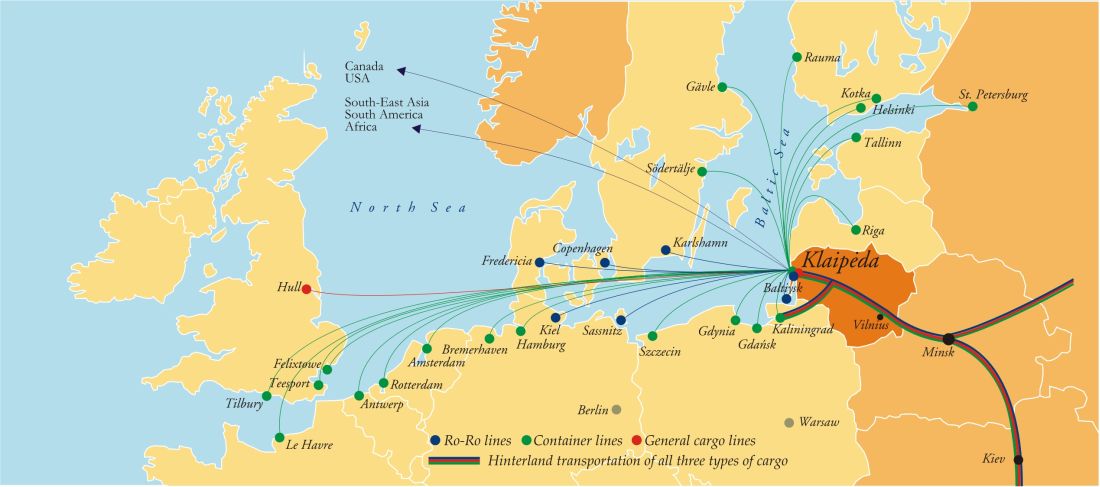
Once this project is implemented, containers arriving to Klaipėda will be reloaded onto smaller ships and distributed across the other Baltic Sea ports, from where simultaneously a new consignment will be collected and transferred back to Klaipėda, to continue its trip further down to the international markets.
Construction of the new container distribution center in Klaipėda is an ambitious project. Its scale and potential compares to that of Rotterdam, Antwerp and Bremerhaven. After completion the container distribution center will be the most advanced and technologically sophisticated transit point for seaborne cargo in the entire Baltic region.
Currently, Klaipėda sea port successfully handles containers arriving by road and by rail and serves as a focal transit point not only for neighboring Russia and Belarus, but also for such remote partners like Kazakhstan or ISAF forces in Afghanistan. But when it comes to reloading containers from larger sea vessels to smaller ones or vice versa, the client’s needs can be met only in isolated individual cases.
The new terminal will transform this situation dramatically, as huge oceanic cargo liners will no longer need to stopover in Western European before reaching the Baltic shores. The time and cost of connecting with vast Eastern markets will be significantly reduced. As a result, the role of Klaipėda sea port in the international chain of logistics will further increase.
"Today oceangoing cargoes bound for the Baltic seaports are distributed mainly through the overburdened harbors of Rotterdam, Antwerp and Bremerhaven. In order to reduce the duration and cost of the journey we have started floating the idea of building a distribution center of our own, in the Baltic Sea region ", - recalls Technical Director of “Klaipėdos Smeltė” Gintaras Sadauskis.
Design and engineering works for the new terminal started in 2011, and the construction process was launched in 2013. A number of important infrastructure upgrades to improve Klaipėda’s overall stevedoring capacity has already been put in place. Thus, new railway lines have been built to facilitate access to the docks; hence additional land was released for container storage facilities. Also, the harbor shipping channel was made deeper (from 13 to 14.5 m) and wider (from 125 to 150 m) to allow the receiving of post-panamax-type container ships with the maximum length of 350 meters.
The new terminal will have the storage capacity of 30,000 TEU and will be able to receive products both regular and frozen. It will also possess three huge “Ship-to-Shore” type cranes, which will rise as high as to 83.6 meters (and with the extended arm up to 115 meters). These cranes will be able to service oceanic container ships of individual 12,000 TEU capacity.
The new container distribution center project is funded jointly by SEB Bank and European Bank for Reconstruction and Development. The total amount of investment stands at around $100 million.
The construction works should complete by the middle of 2014.
See full unabridged article here (in Lithuanian).
Source : structum.lt


Social media


