


“The most a translator can do is to keep a good book unspoiled”, says the Lithuanian translator of “Shantaram” and “A Fine Balance”
Those who have read Gregory D. Robert’s Shantaram will agree that some books cannot be finished but in one go. A new piece in this category has just recently reached the bookshelves of the Lithuanian bookstores – a Lithuanian translation of Rohinton Mistry’s A Fine Balance – and has immediately earned the readers’ acclaim.
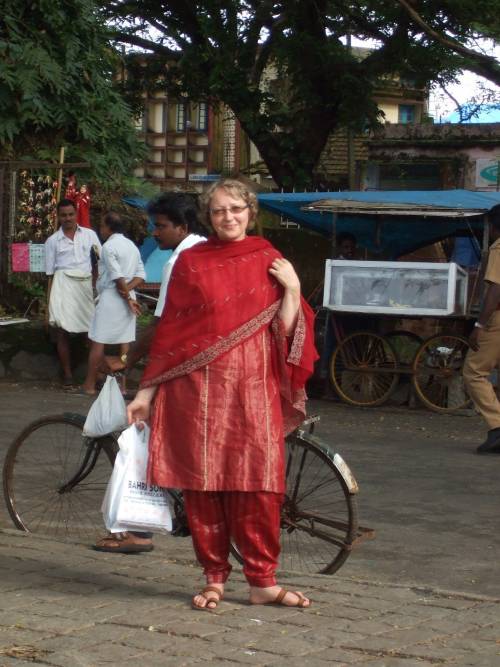
Lolita Černiauskaitė from the national daily Lietuvos rytas talks to Danguolė Žalytė, one of the most valued and productive Lithuanian translators. A resident of a small township of Anykščiai, she was selected as the Best Translator of the Year in 2007 by the Lithuanian PEN Centre. She is also one who’s got infected with the ‘India virus’ long time ago and has exploited her ‘sickness’ for bringing two distant cultures, Indian and Lithuanian, together.
- The list of your works is truly impressive. Do you always pick up yourself which books to translate? And since so many works you have translated are about India, what is your personal relationship with this faraway country?
- My choice of books to translate is never mine. I take what I’m given [by the publisher]. Many texts I’ve had to work with are nothing but a junk. But when translation is your bread and butter, you can’t be too choosy.
What connects me with India is a mystery to myself. But I know for sure how and when this relationship started. I was five years old, staying with my grandma, when the Bollywood hit “Gunga Jumna” arrived and was screened at the local community center. It was dubbed in Russian. Such a colorful piece! And the music… it really got me spellbound. I am still under the lock of that spell.
This experience was my departure point. I started reading books about India, then books by Indian authors, then I learned some Hindi... I eventually travelled to India, and the magnetism of this country still keeps pulling me like it did when I was a five-years-old girl, sobbing at night over the inadvertent killing of the noble outlaw’s sweetheart and, of course, the noble outlaw himself… Perhaps this magnetism comes from the knowledge that India is so unique.
- You have translated both Shantaram and the freshly released A Fine Balance. Can you compare the two books? Which one has been more difficult to translate?
- Shantaram is a high-quality commercial read. Meanwhile, A Fine Balance is an outstanding literature. Translating Shantaram was perhaps more difficult from the technical point of view, especially when it comes those parts involving weaponry... But translating A Fine Balance was no doubt an emotional challenge. In particular, the last thirty pages… they nearly broke my heart. I mean it. I simply cannot stand it when someone who’s already down is further abused. When small defenseless people are ruined emotionally or, like in this book, even physically.
Shantaram is fun, it is full of riddles and mysteries. You solve one riddle and immediately stumble upon another. Whereas A Fine Balance... it’s hard to tell. Maybe it’s about how much a man can bear. And that in the end only human kindness counts and makes a difference. You only have as much as you give to the others. Even when you have nothing left for yourself. Here the episode of the quilting resurfaces in my memory, and my heart is breaking again…
- The books on India, how much do they match with the common perception that India is a land of enlightened, spiritual people?
- I believe the books by the Indian writers reflect the reality on the ground. Their protagonists are neither enlightened nor spiritual. Neither are contemporary Indians. Yes, India is a religious nation. It has innumerous festivals dedicated to countless deities. But also lately – I cannot tell you how it used to be before – many Indians have switched to worshipping money.
For example, there are temples where non-Hindus aren’t welcome. All tourist guidebooks warn you about this. Ha-ha! Show the gatekeeper a five rupee banknote and you will be admitted. Such was my way to the Kali temple somewhere in Tamil Nadu: 2,000 rupees opened all the gates.
Whereas our experience in Kanaka Durga Temple was another extreme. With the sea of pilgrims and under the shower of police batons we were climbing the steps up to heaven. Yet the pace was so quick that I apparently missed the moment to see the idol. Having spotted my fair skin and a knuckleheaded face, an earnest policewoman grabbed me by the scruff of the neck, put my hands on my chest and ordered to repeat obediently: “Mata ki jai!” Despite my efforts (and my generous offering), Brahmin the Villain still didn’t offer me his blessings (laughs).
Today, on Indian TV channels you will find a myriad of advertisings urging you to buy a miraculous medallion of Hanuman or Lakshmi, which would make you healthy, prosperous, and happy. You have no job? No problem, the medallion will help you find one! Health issues? All of them will be overcome! Harmony will arrive to your family, and all your financial problems will be resolved once and for all (laughs).
- Can the book you translate impact your own life? Can the mood of the book be contagious?
- A good book will always leave an imprint. And the mood can spread like a virus. One can lose his sleep and peace of mind and stay in this condition long after the translation had been finished. That’s what happened to me after having completed A Fine Balance.
I always immerse, fully and wholeheartedly, in the text I’m working with. And this perhaps my greatest tragedy. Because every such immersion is like a self-committed rape. But otherwise I wouldn’t be able to do my job. Or translation would be of very poor quality. This has happened to me before.
- And can the translator determine the fate of a book – make it a hit or a flop?
- No, I don’t think so. The translator cannot determine the fate of the book. The most he can do is to keep a good text unspoiled. And if he’s got a bad text to trans-late, it is his duty to make his distaste invisible.
See full unabridged text at: kultura.lrytas


Social media


