


“The possibility of being free and feeling free is among the largest accomplishments of our Independence,” says Lithuanian Ambassador



The 25th anniversary of restoration of free and independent Lithuania was celebrated in New Delhi on Wednesday, March 11.
“Of all the fruits the 11th of March Declaration [of Independence] has borne, the possibility of being free and feeling free is perhaps the sweetest one,” Lithuanian ambassador to India Laimonas Talat-Kelpša said to the large crowd of guests and friends of Lithuania who gathered at the premises of the Embassy to mark the occasion.
“This is what Lithuania has become today: a free, fast-growing, and resourceful nation, looking for the best possible ways to protect the human dignity of its every man and woman,” the Ambassador noted.
On March 11, 1990 the Supreme Council of Lithuania, the first freely elected parliament after 50 years of Soviet occupation, proclaimed the reestablishment of “the execution of sovereign powers [that were] abolished by foreign forces in 1940” and declared that “Lithuania is again an independent state.”
To mark the Restoration of Independence Day, an exhibition “Being Human” by two leading Lithuanian textile artists, Aušra Kleizaitė and Monika Žaltauskaitė-Grašienė was opened in the Embassy’s courtyard.
Aušra Kleizaitė’s collection, called “Human Windows,” represents nearly 20 one-size charcoal drawings on pressed wood panels wherein “our life experiences, large and small, reemerge.”
“These human portraits should provide a glimpse into man’s soul,” says the author, herself a graduate of Vilnius Academy of Fine Arts, who has also spent a number of years in India.
Meanwhile, Professor Monika Žaltauskaitė-Grašienė, who is concurrently the Head of the Textile Department at the Kaunas Faculty of Vilnius Academy of Fine Arts, is focused on the various dimensions of human feelings and emotions.
Her three-piece composition “Safe,” reproduced in digital jacquard weaving technique, depicts a father holding a baby in his palms, a bid to recreate “the sense of security-cum-uncertainty so much prevalent in each of us.”
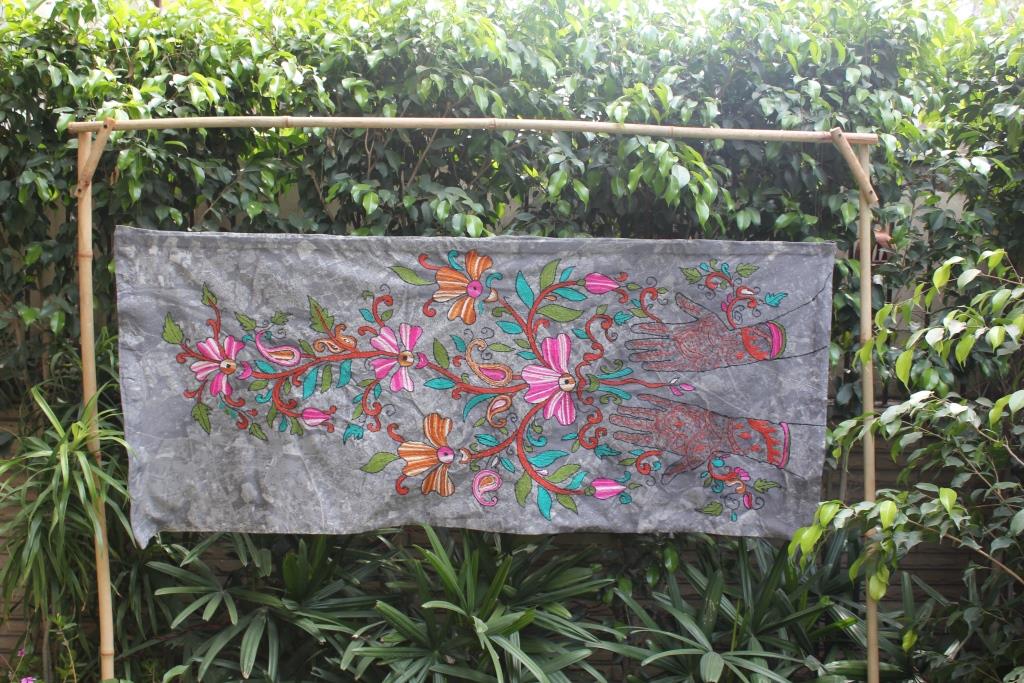
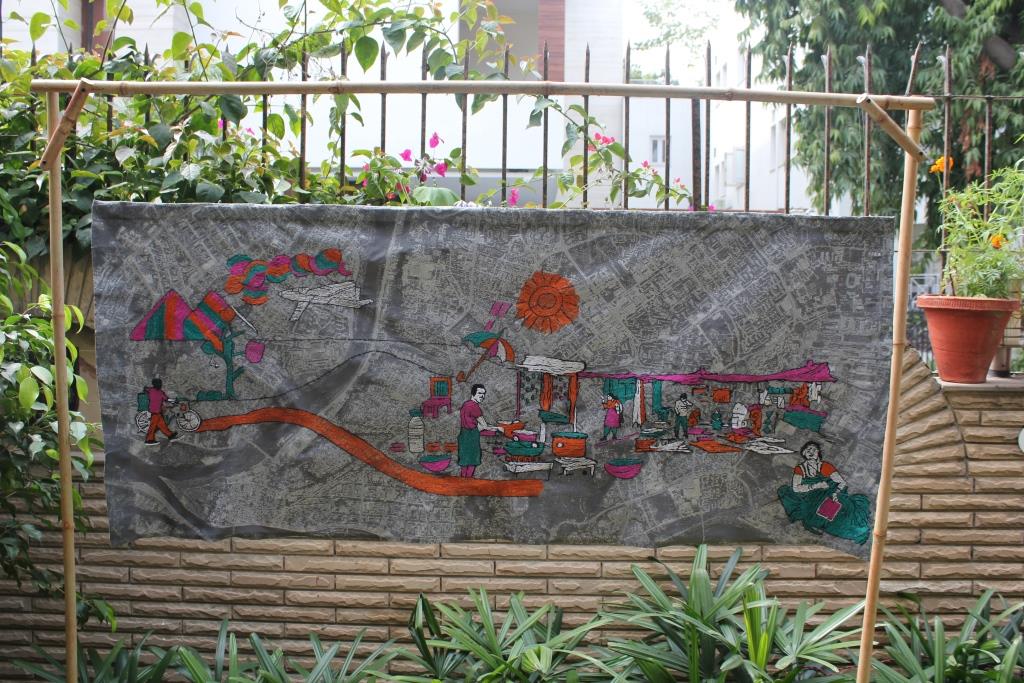
The next four-piece composition, “Distances,” skillfully combine modern artistic approaches with Lithuanian and Indian ethnic traditions. Four digitally woven canvases portray the satellite images of Kaunas, Lithuania’s second largest city, upon which the traditional Kantha embroidery was applied by a local master from West Bengal.
“These Google Maps images of different zoom levels actually represent my own house in Kaunas,” says the Professor. “Yet the final touch was provided by a Bengali master who has embroidered thereon his own daily life situations and recreated the unique feeling of India.”
The exhibition by the two Lithuanian textile artists is already the sixth visual arts event held in the courtyard of the Lithuanian Embassy in Delhi.


Social media


